
Cable containment infrastructure designed for ultra-high-density cable environments including AI computing facilities, hyperscale data centers, telecom core rooms, network aggregation areas, and high-capacity communication hubs, covering dense fiber routing, multi-layer tray architecture, rack-level organization, and scalable cable distribution systems.
Scenario Challenges — Engineering Constraints in High-Density Routing Environments
Extreme Cable Fill Ratios in Limited Routing Space
High-density facilities frequently concentrate large quantities of fiber optic, power, and communication cables within restricted overhead or underfloor routing zones. Excessive fill ratios increase thermal buildup, maintenance difficulty, and cable stress.
Typical Engineering Conditions
Tray fill ratios exceeding 50%
Dense MPO/MTP fiber deployment
Mixed power and communication pathways
Limited overhead routing space
Bend-Radius Protection in Dense Fiber Infrastructure
Ultra-high-density fiber systems require strict bend-radius control to prevent signal degradation and long-term cable damage during installation or future MAC operations.
Typical Engineering Conditions
High-count fiber trunks
Continuous cabinet patching
Frequent routing changes
Narrow routing transitions
Multi-Layer Routing & Segregation Complexity
High-density environments typically require multiple routing layers to separate backbone fiber, horizontal distribution, power cabling, and low-voltage systems while maintaining maintenance accessibility.
Typical Engineering Conditions
Overlapping tray systems
A/B redundant pathways
EMI-sensitive routing zones
Shared support structures
Continuous MAC Operations Under Live Conditions
Large communication environments require continuous move, add, and change operations without disrupting active services. Cable support systems must allow future expansion while maintaining organized routing.
Typical Engineering Conditions
Live routing modifications
Cabinet expansion activities
Temporary cable additions
Ongoing infrastructure upgrades
Solution Architecture — High-Density Routing Topology
System Routing Topology
Core Network Equipment
        ↓
Main Backbone Fiber Corridor
        ↓
Multi-Layer Overhead Tray Structure
        ↓
A/B Segregated Distribution Pathways
        ↓
Horizontal Rack Distribution Zone
        ↓
Rack Drop Assemblies
        ↓
High-Density Cabinets / Active Equipment
Routing Layer Logic
| Routing Layer | Main Function | Engineering Priority |
|---|---|---|
| Backbone Routing Layer | Main fiber trunk distribution | Long-span load stability |
| Segregated Distribution Layer | A/B pathway separation | Routing redundancy |
| Horizontal Distribution Layer | Rack-level branch routing | Maintenance accessibility |
| Rack Entry Layer | Final cabinet cable organization | Bend-radius protection |
Zone-Based System Design
1. Backbone Fiber Routing Corridor
Recommended System
- Heavy-Duty Ladder Cable Tray System
Routing Scope
- Core network backbone routing
- Main fiber trunk pathways
- High-capacity communication corridors
Recommended Engineering Parameters
- Tray width: 600–900 mm
- Load capacity: 75–150 kg/m
- Recommended support span: 3–5 m
- Maximum deflection: L/200
- Fill ratio recommendation: ≤45%
Recommended Materials
- Aluminum alloy
- Hot-dip galvanized steel
- Stainless steel
Why This System Is Recommended
Provides stable support for high-volume trunk cable routing while maintaining structural rigidity over long spans.
Related Products
- Heavy-Duty Ladder Tray
- Long-Span Support Brackets
- Expansion Splice Systems
2. Multi-Layer Distribution Zone
Recommended System
- Wire Mesh Cable Tray System
Routing Scope
- High-density fiber distribution
- Horizontal branch routing
- Multi-level communication pathways
Recommended Engineering Parameters
- Open airflow structure
- Rapid field modification capability
- Multi-layer installation compatibility
- Recommended fill ratio ≤40%
Recommended Materials
- Electro-galvanized steel
- Stainless steel
- Powder-coated steel
Why This System Is Recommended
Supports flexible routing adjustments and simplifies cable additions during continuous infrastructure expansion.
Related Products
- Wire Mesh Cable Tray
- Multi-Tier Support Assemblies
- Radius Forming Accessories
3. Segregated Power & Fiber Routing Zone
Recommended System
- Perforated Cable Tray + Divider System
Routing Scope
- Power/fiber segregation
- Low-voltage communication routing
- Parallel distribution pathways
Recommended Engineering Parameters
- Optional divider plates
- EMI separation compatibility
- Ventilated tray structure
- Support spacing: 1.5–2.5 m
Recommended Materials
- Pre-galvanized steel
- Powder-coated steel
- Aluminum alloy
Why This System Is Recommended
Maintains organized cable segregation while supporting maintenance accessibility and airflow performance.
Related Products
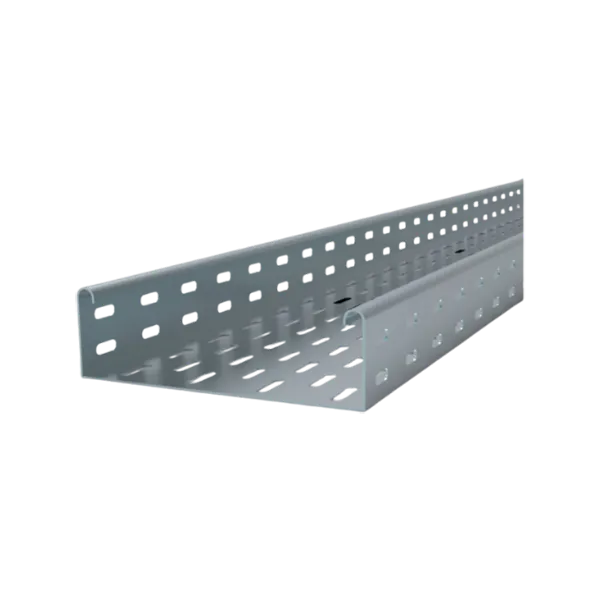
- Perforated Cable Tray
- Divider Plates
- Segregated Support Brackets
4. Rack Entry & High-Density Cabinet Zone
Recommended System
- Fiber Raceway + Vertical Cable Management System
Routing Scope
- Cabinet cable drops
- High-density patching zones
- Rack-level fiber organization
Recommended Engineering Parameters
- Bend-radius protection ≥10× cable OD
- Front/rear cable separation
- High-density patching support
- Toolless accessory installation
Recommended Materials
- Flame-retardant engineering plastic
- Powder-coated steel accessories
Why This System Is Recommended
Critical for maintaining signal integrity and organized routing within dense cabinet environments.
Related Products
- Fiber Raceway System
- Vertical Cable Manager
- Rack Drop Components
Recommended Products — Engineering Selection Guide
Backbone & Long-Span Routing Systems
| Product | Recommended Application | Key Parameters | Recommended Certifications |
|---|---|---|---|
| Heavy-Duty Ladder Tray | Main fiber backbone routing | 150 kg/m load capacity | IEC 61537 / NEMA VE-1 |
| Aluminum Ladder Tray | Long-span overhead routing | Lightweight structure | IEC 61537 |
| Expansion Splice System | Future tray extension | Modular connection design | IEC installation standards |
Why These Products Are Recommended
Designed for stable backbone routing and future expansion in high-density infrastructure.
High-Density Distribution Systems
| Product | Recommended Application | Key Parameters | Recommended Certifications |
|---|---|---|---|
| Wire Mesh Cable Tray | High-density communication routing | Open airflow structure | IEC 61537 |
| Multi-Tier Support System | Multi-layer tray installation | Space optimization | Structural load testing |
| Radius Forming Accessory | Fiber routing transition | Bend-radius protection | TIA standard |
Why These Products Are Recommended
Optimized for flexible routing changes and high-density cable organization.
Rack-Level Organization Systems
| Product | Recommended Application | Key Parameters | Recommended Certifications |
|---|---|---|---|
| Fiber Raceway System | Cabinet fiber routing | Controlled bend radius | TIA-942 |
| Vertical Cable Manager | Rack cable organization | Front/rear segregation | ANSI/TIA-568 |
| Divider Plate System | Power/fiber separation | Independent routing channels | IEC installation standards |
Why These Products Are Recommended
Improve maintenance efficiency and routing visibility within dense cabinet environments.
Technical Compliance & Certification Standards
IEC 61537 — Cable Tray & Cable Ladder Systems
Defines mechanical testing, load performance, and grounding continuity requirements.
Procurement Value
Ensures structural stability under high cable density and long-span routing conditions.
TIA-942 — Telecommunications Infrastructure Standard
Defines routing hierarchy, cabling separation, and infrastructure planning for data center environments.
Procurement Value
Supports scalable high-density routing architecture and maintenance accessibility.
ANSI/TIA-568 — Structured Cabling Standard
Defines telecommunications cabling topology and installation requirements.
Procurement Value
Ensures compatibility with high-performance structured cabling systems.
EN ISO 12944 — Corrosion Protection Standard
Defines corrosion protection categories and coating system durability requirements.
Procurement Value
Supports long-term durability of metallic routing systems in controlled or humid environments.
Project References — High-Density Routing Deployments
AI Computing Infrastructure Facility — North America
Project Overview
- High-density AI computing facility supporting GPU clusters and ultra-high-count fiber deployment.
System Scope
- Heavy-duty backbone ladder trays
- Multi-layer wire mesh routing systems
- Fiber raceway assemblies
- Rack-level cable management systems
Quantified Results
- Total routing installation: 310 km
- Supported 400G/800G fiber architecture
- Reduced cable congestion by 38%
- Improved maintenance accessibility during live operation
Engineering Highlights
Implemented segregated multi-layer routing architecture with dedicated A/B fiber pathways.
Telecom Core Network Facility — Europe
Project Overview
- Carrier-grade communication hub supporting high-density backbone interconnections.
System Scope
- Multi-tier overhead routing systems
- Segregated perforated tray systems
- Vertical cable organization assemblies
Quantified Results
- Supported over 25,000 communication connections
- Reduced future expansion installation time by 27%
- Passed third-party routing and load verification
Client Feedback
“Structured multi-layer routing significantly improved future cable expansion and maintenance efficiency.”
Technical Resources & Engineering Support
Available Downloads
- High-Density Routing Design Guide
- Fiber Bend-Radius Planning Manual
- BIM/Revit Routing Models
- Tray Load Calculation Tables
- Multi-Layer Routing Drawings
- IEC 61537 Test Reports
- Structured Cabling Layout References
Next-Step Actions
Consult High-Density Routing Architecture
Review routing density, segregation requirements, and future expansion strategy with engineering teams.
Request High-Density Installation Samples
Evaluate tray structure, cable organization accessories, and routing compatibility before deployment.
Download High-Density Cable Infrastructure Manual
Access detailed routing topology, engineering standards, and installation references for high-density environments.