
Cable containment infrastructure designed for hyperscale cloud campuses, AI computing facilities, and large-scale colocation data centers, covering backbone fiber routing, high-density white space distribution, overhead cable pathways, A/B redundancy architecture, and scalable expansion deployment from MMR to server row level.
Scenario Challenges — Engineering Constraints in Hyperscale Facilities
Extreme Fiber Density in AI & Spine-Leaf Architectures
Modern hyperscale facilities using Spine-Leaf network topology and AI cluster architecture require extremely high fiber density between core switches, aggregation layers, and GPU clusters. Traditional tray systems often fail to maintain cable organization, bend-radius control, and maintenance accessibility under ultra-high-density routing conditions.
Typical Engineering Conditions
400G / 800G fiber deployment
High-count MPO/MTP trunk cables
Dense overhead routing above hot aisle containment
Continuous cabinet expansion requirements
Long-Span Overhead Routing Stability
Backbone routing between MMRs, MDAs, and white space zones frequently requires long-span overhead installation above active equipment areas. Insufficient tray rigidity can result in excessive deflection, support overload, and vibration-related cable stress.
Typical Engineering Conditions
Support span: 3–6 m
Heavy backbone fiber bundles
Combined power and communication routing corridors
Ceiling suspended infrastructure systems
A/B Redundancy & Segregated Routing Requirements
Tier III and Tier IV data center architecture requires physically separated A/B cable pathways to maintain infrastructure redundancy. Improper routing hierarchy increases operational risk during maintenance or future expansion.
Typical Engineering Conditions
Dual-path backbone routing
Segregated fiber and power systems
Independent maintenance corridors
Concurrent maintainability requirements
Continuous Expansion Without Downtime
Hyperscale campuses are typically deployed in multiple construction phases. Cable management systems must support future expansion, tray extension, and rack deployment without interrupting active operations.
Typical Engineering Conditions
Live white space expansion
Modular server hall deployment
Reserved tray capacity planning
Expansion-ready support structures
Solution Architecture — Hyperscale Cable Routing Topology
System Routing Topology
Utility Entrance
        ↓
Meet-Me Room (MMR)
        ↓
Main Distribution Area (MDA)
        ↓
Core Backbone Ladder Tray Corridor
        ↓
A/B Redundant Overhead Routing
        ↓
Spine Fiber Distribution Zone
        ↓
Row-Level Distribution Trays
        ↓
Rack Drop Assemblies
        ↓
Server Cabinets / AI Clusters
Routing Layer Logic
| Routing Layer | Main Function | Routing Priority |
|---|---|---|
| MMR Backbone Layer | Interconnection & carrier entry | Highest redundancy requirement |
| Core Overhead Corridor | Main trunk routing | Long-span load stability |
| Spine Distribution Layer | High-density fiber deployment | Cable segregation & scalability |
| Row-Level Distribution | Rack-level branch routing | Maintenance accessibility |
| Rack Drop Layer | Final cabinet entry | Bend-radius protection |
Zone-Based System Design
1. MMR to MDA Backbone Corridor
Recommended System
- Heavy-Duty Ladder Cable Tray System
Routing Scope
MMR → MDA
Inter-building backbone corridors
Core network fiber pathways
Main power distribution routing
Recommended Engineering Parameters
Tray width: 600–900 mm
Load capacity: 75–150 kg/m
Recommended support span: 3–6 m
Maximum deflection: L/200
Fill ratio recommendation: ≤45%
Recommended Materials
Hot-dip galvanized steel
Aluminum alloy
Pre-galvanized steel (indoor dry areas)
Why This System Is Recommended
Long-span backbone routing requires high structural rigidity and stable support performance under dense fiber and power cable loads.
Related Products
- HDG Ladder Cable Tray
- Aluminum Ladder Tray
- Heavy-Duty Support Bracket System
2. Overhead Spine Fiber Distribution Zone
Recommended System
- Wire Mesh Cable Tray + Fiber Raceway System
Routing Scope
- Spine switch interconnections
- High-density fiber distribution
- AI cluster routing
- Cross-aisle overhead pathways
Recommended Engineering Parameters
- Fiber bend radius ≥10× cable OD
- Open structure for airflow optimization
- Segregated routing for A/B pathways
- Recommended fill ratio ≤40%
Recommended Materials
- Electro-galvanized steel
- Stainless steel
- Powder-coated mesh systems
Why This System Is Recommended
Mesh systems simplify field modification and support rapid deployment in continuously expanding white space environments.
Related Products
- Wire Mesh Cable Tray
- Fiber Raceway System
- Fiber Drop Accessories
3. Row-Level Distribution Zone
Recommended System
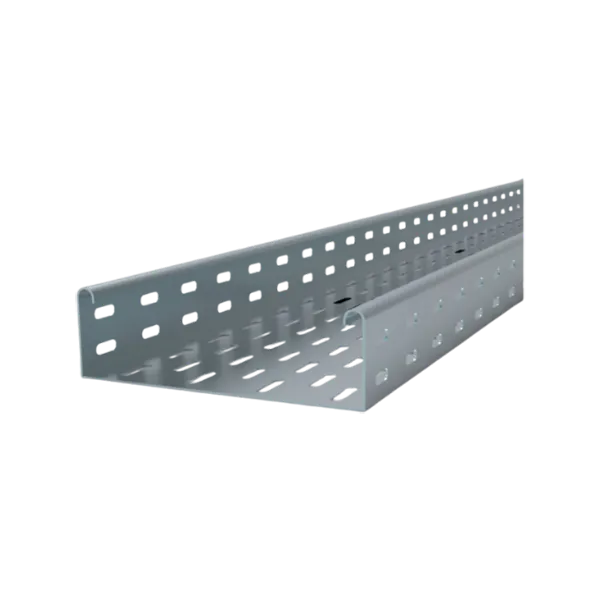
- Perforated Cable Tray System
Routing Scope
- Row-to-row branch routing
- Rack distribution pathways
- Secondary power and communication routing
Recommended Engineering Parameters
- Tray width: 150–450 mm
- Recommended support spacing: 1.5–2.5 m
- Optional divider plates for cable segregation
- Ventilated structure for thermal management
Recommended Materials
- Pre-galvanized steel
- Powder-coated steel
- Aluminum alloy
Why This System Is Recommended
Provides balanced airflow, cable support stability, and simplified maintenance access in dense rack environments.
Related Products
- Perforated Cable Tray
- Divider Systems
- Horizontal Support Assemblies
4. Rack Drop & Cabinet Entry Section
Recommended System
- Fiber Raceway + Vertical Cable Management System
Routing Scope
Overhead tray → cabinet entry
Rack-level fiber organization
Patch panel routing
Recommended Engineering Parameters
Controlled bend-radius protection
Toolless drop-out accessories
Front/rear cable separation
High-density patching compatibility
Recommended Materials
Flame-retardant engineering plastic
Powder-coated steel accessories
Why This System Is Recommended
Critical for maintaining fiber integrity and maintenance accessibility in high-port-density environments.
Related Products
- Fiber Raceway System
- Vertical Cable Manager
- Rack Drop Assembly
Recommended Products — Engineering Selection Guide
Backbone Routing Systems
| Product | Recommended Application | Key Parameters | Recommended Certifications |
|---|---|---|---|
| Heavy-Duty Ladder Tray | MMR backbone routing | 150 kg/m load capacity | IEC 61537 / NEMA VE-1 |
| Aluminum Ladder Tray | White space overhead routing | Lightweight long-span structure | IEC 61537 |
| Seismic Support System | Tier III / IV facilities | Lateral restraint support | IBC / ASCE 7 |
Why These Products Are Recommended
Designed for long-span backbone routing with high structural rigidity and future expansion capability.
High-Density Fiber Routing Systems
| Product | Recommended Application | Key Parameters | Recommended Certifications |
|---|---|---|---|
| Wire Mesh Cable Tray | Spine fiber distribution | Rapid field modification | IEC 61537 |
| Fiber Raceway System | Cabinet fiber protection | Bend-radius control | TIA-942 |
| Fiber Drop Accessories | Rack entry management | Toolless installation | TIA standards |
Why These Products Are Recommended
Optimized for high-density fiber deployment and continuous MAC operations.
Rack-Level Distribution Systems
| Product | Recommended Application | Key Parameters | Recommended Certifications |
|---|---|---|---|
| Perforated Cable Tray | Rack row distribution | Ventilated tray body | IEC 61537 |
| Vertical Cable Manager | Rack cable organization | Front/rear separation | ANSI/TIA-568 |
| Divider Plates | Power/fiber segregation | Independent routing channels | IEC installation standards |
Why These Products Are Recommended
Improve maintenance accessibility while maintaining airflow and cable segregation.
Technical Compliance & Certification Standards
IEC 61537 — Cable Tray & Cable Ladder Systems
Defines mechanical load testing, grounding continuity, and structural performance requirements.
Procurement Value
Ensures tray systems are structurally verified for high-load backbone deployment.
TIA-942 — Telecommunications Infrastructure Standard for Data Centers
Defines routing hierarchy, redundancy architecture, and cabling segregation for modern data centers.
Procurement Value
Supports standardized hyperscale infrastructure design and future scalability.
EN ISO 12944 — Corrosion Protection Standard
Defines corrosion categories and coating performance requirements for steel structures.
Procurement Value
Helps determine suitable coating systems for humid cooling zones and rooftop installations.
NEMA VE-1 — Metal Cable Tray Systems
North American standard for tray structural performance and installation requirements.
Procurement Value
Simplifies compliance alignment for U.S.-based projects.
Project References — Hyperscale Deployments
AI Cloud Computing Campus — Southeast Asia
Project Overview
- Hyperscale AI computing campus supporting GPU cluster deployment and high-density fiber architecture.
System Scope
- Heavy-duty ladder trays
- Wire mesh fiber routing systems
- Fiber raceway assemblies
- A/B redundant overhead routing
Quantified Results
- Total tray installation: 420 km
- Backbone support span: up to 5.5 m
- Installation efficiency improved by 28%
- Supported live expansion without service interruption
Engineering Highlights
Implemented independent A/B backbone routing with segregated fiber corridors for concurrent maintainability.
Tier IV Colocation Facility — Middle East
Project Overview
- Multi-tenant colocation facility requiring redundant backbone routing and phased white space deployment.
System Scope
- Aluminum ladder systems
- Rack-level perforated trays
- Seismic support structures
Quantified Results
- Supported over 18,000 cabinet connections
- Reduced overhead structural load by 22%
- Passed third-party structural verification
Client Feedback
“Modular routing architecture significantly simplified future expansion planning while maintaining operational continuity.”
Technical Resources & Engineering Support
Available Downloads
- Hyperscale Cable Routing Design Guide
- MMR Backbone Layout Drawings
- BIM/Revit Models
- Tray Load Span Calculation Tables
- Seismic Bracing Design Guide
- IEC 61537 Test Reports
- Corrosion Protection Specifications
Next-Step Actions
Consult Hyperscale Backbone Routing Design
Discuss routing hierarchy, load conditions, and redundancy architecture with engineering teams.
Request White Space Installation Samples
Evaluate tray structure, coating quality, and accessory compatibility before procurement approval.
Download AI Cluster Cable Infrastructure Manual
Access detailed routing topology, engineering parameters, and installation references for hyperscale facilities.